

| February 9th |
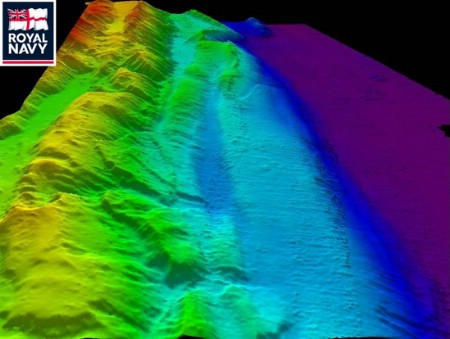
A Royal Navy 3 dimensional computer generated graphic released February 9, 2005 shows the seabed in the vicinity of the recent devastating tsunami earthquake epicentre in South Asia. The multi-coloured images, produced from a survey by HMS Scott, depict a hostile, angry landscape where the earthquake triggered several landslides around 100 metres high and 200 metres long and created new cracks hundreds of metres long in the seabed. This work has been carried out to aid the establishment of an Indian Ocean Tsunami Warning System. The bright blue line would seem to show where the two plates of the earths crust came together and the one on the right of the picture rose up and over the one on the left. Scientists this week also predicted that another substantial Indian Ocean Tsunami was likely within the next few decades - perhaps even within 5 years. |
| Thais love leader who met tsunami challenge THAKSIN SHINAWATRA, the Thai Prime Minister, claimed the most overwhelming election victory in his country’s history last night, as voters rewarded him for his decisive actions after the Asian tsunami. Thailand’s long history of political instability and intermittent military coups ensured that no previous prime minister had succeeded in surviving even one four-year term. Yet Thai Rak Thai far outstripped the 295 seats that it won in 2001 and seemed confident of being able to govern without its coalition partner, Chart Thai. Mr Thaksin’s popularity owes much to his rural development programmes, which have bestowed cheap loans and subsidised health care on Thailand’s poor rural areas, as well as to his aggressive approach to problems such as the drugs trade. However, it was his reaction to the Boxing Day tsunami that won him a crushing, rather than merely a decisive, victory. Accompanied by teams of reporters, he made repeated visits to the stricken fishing villages and beach resorts of Thailand’s west coast, where more than 5,300 Thais and foreign tourists died on December 26. Yesterday voters on the west coast queued at polling stations close to fields of debris, still uncleared seven weeks after the tragedy. At the village of Ban Namkhem, where many deaths occurred, the wreckage of a fishing boat carried inland by the powerful wave lay close to a polling station in a school. All but a handful of people have abandoned the area and voters were transported to the polls from their refugee camps in army lorries and fishing boats. “There were 3,000 people registered here, but we don’t know how many will come today because we’ve no idea how many are dead or missing,” Praiyun Jongkraijak, a fisherman, said. “It’s very hard for people, but most want to come and vote. They are spread out and they have no transportation, No car, no nothing. They’ve lost everything.” |
| VALENTINES DAY - February 14th |
| Are you as confused as I am? This last weekend we spoke to the temporary camp at Baan Maung camp again to check what was being received and to see if any official notification of new permanent homes or fishing boats had been received - nothing. On the other hand I am sure I remember reading that the government were wanting to make sure that all families would receive cash aid by the end of January. Also today I heard that some charities have so much money that they no longer want money for Tsunami victims and may need to go back to subscribers to ask if they can redirect their cash to other good causes or alternatively send the money back. What a shame that all of the cash sent in all haste to aid Tsunami victims is proving so hard to spend in the short term. |
| In the Phuket Gazette this week we hear that all Foreign aid volunteers assisting in tsunami-related charity work are required to hold work permits, regardless of whether they are being paid for their efforts or not. Sayan Chuaiyjan, head of the Phuket Provincial Employment Service Office [ESO], told the Gazette on February 8 that there could be no exceptions and that his office would begin to enforce the regulations soon – possibly next month. “There can be no exceptions. Work is work, even if it is for charity,” he said. He urged relief workers to apply for work permits and added that those working for recognized charitable organizations would find them easy to obtain. “They can just present a document certified by the charity organization they work for [proving their need to be here] and we will issue them with work permits, then they will be able to work legally,” he said. He pointed out that any foreigner caught working without a work permit is liable to hefty punishment. “If our officers, police officers or immigration police learn [of foreign volunteers] who don’t have work permits, the maximum penalty is three years in jail, a 30,000 baht fine [or both],” he warned. |
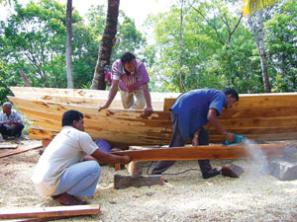
| Koh Lanta, in Krabi Province, has one of the largest fishing communities in Thailand. For fishermen, their lives are their boats and their boats are their lives, and for many, both boats and lives were shattered by the December tsunami. The Fisherman’s Fund was established to help rebuild these communities after the tsunami and took delivery of two boats for the beleaguered fishermen of Koh Lanta. Bang Lean, who has been building boats for 10 years, says it takes up to 10 days to make a boat. The fund has given this small community enough money to build 22 boats, at a cost of around 50,000 baht apiece. K. Bang says the price of the wood used to build boats has soared since the tsunami, from 60-90 baht a board-meter to 100 baht. Even so, he and his colleagues are making boats as fast as they can. Duane Lennie, of the Fishermen’s Fund, explains that the government plans to donate boats to the fishermen, but, he notes, “It will take three to six months for the boats to come through, and, for the fishermen, that is too long a time. “The boats are too expensive for the fishermen. Some of them earned less than 10,000 baht a month before the tsunami, and it costs 40,000 baht [or more] to build one boat, so they can’t afford to buy new ones.” |

To donate to or find out more about the Fishermen’s Fund, contact Duane Lennie at Tel: 06-8812121, email duane@mangonation.com or website: www.kolanta.net |
| MEANWHILE........... |
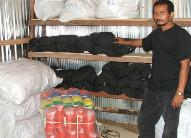
This week we received agreement to send another 20 television sets for the Baan Maung camp - this will mean approximately 1 TV per 35 - 40 family's, we will also add another few hundred electric irons, which many of the family's have requested. Hopefully this will all help further with getting people settled down more comfortably and assist especially the children. The fishing tackle and nets we delivered are almost assembled now and the first of the boat wood is due to arrive this week. We are now arranging a second load of nets and boat tackle in an effort to keep up with maintaining supplies, impetuous and the general effort to get as many boats back to sea as possible in the short term. |
| 21 FEBRUARY updates from the Newspapers ........... |
| B2 billion tsunami memorial proposed PHUKET CITY: On February 15 the Cabinet was due to consider a proposal to spend up to 2 billion baht on building a memorial to the victims. A dome is being proposed with a high-tech “crystal” prism to display the names of known victims. The dome would be built in the sea off Bang Niang Beach, Khao Lak, next to a 300-rai plot of state land set aside to remember the tsunami. |
| B18bn lent to tsunami victims – so far PHUKET: By the end of January the island’s commercial banks had lent 18 billion baht to 660 Phuket individuals and businesses hit by the tsunami. After the tsunami, the Bank of Thailand set aside 37 billion baht to allow commercial banks to provide soft loans to tsunami victims. The Bank of Thailand will charge the borrowing banks 0.01% interest, and they will not be allowed to charge borrowers more than 2%. |
| State aid is a tangled mess The news that commercial banks in Phuket and surrounding provinces have been lending billions of baht to businesses and individuals affected by the tsunami – and also restructuring existing loans for others so that they have a chance of recovering from the disaster – is heartening. What is far less encouraging is the continuing criticism of the government and the bureaucracy by people who have been promised help but who have yet to receive it. The Baan Man Kong initiative to provide homes for people made homeless by the tsunami is faltering badly. One interviewee commented, “Ordinary farang (foreigners) have helped me more – someone walked in and gave me 2,000 baht.” That a cash donation of 2,000 baht should be thought of as being more helpful than anything the government has done is a sad commentary indeed on the current state of affairs. What is true of homes is also true of boats. Small fishing villages all along the Andaman coast are living in a limbo of handouts because they cannot afford to replace the boats, nets and crab traps that allowed them to make a living. There seem to be two reasons why this aid is not forthcoming. The first is plain old-fashioned corruption. The government’s solution to reported exaggeration by officials of victims’ needs has been to cut back the amount of aid it plans to allocate. So now victims will receive even less, once the sticky-fingered bureaucrats and local community “leaders” have taken their slice. The other reason is ironic: the delay is due in great part to rules introduced to prevent corruption. These have resulted in a complex maze of red tape, checks and counter-checks that victims must navigate before, perhaps, getting a couple of hundred baht. The next day they must navigate this maze all over again. The Gazette has received many requests from people overseas who want to help victims, but who stress that they do not want their money to go anywhere near the so-called civil servants. What a shameful indictment. |
| Sea Gypsies protest ‘lack of govt help’ PHUKET: More than 50 Sea Gypsies from Rawai rallied outside the offices of Phuket Governor on February 9 to protest at what they say is a lack of help from the government since the tsunami. Bangkok has said it would make one-off payments of 2,000 baht to anyone who lost his or her job because of the tsunami. But Sea Gypsy Kwanjit Bangjark said she has not received anything from the government so far. “I wanted to work in the program for jobless people, which pays 175 baht a day, but the officers told me that if I did that, I wouldn't’t receive the 2,000 baht. But one month on, I haven’t received either,” she said. Tiya Buathong claimed that the only people who have been helped are those who are “close” to government officers. She said that when she went to claim her cash on January 7, she was told all the money had been already been given away, and that she must wait for more to come through. More than a month later, she is still waiting, having been passed from Tambon Administration Organization (OrBorTor) officers to the Governor’s office and back. |
| BUSH-CLINTON VISIT: Face to face with tragedy Published on February 20, 2005 Ex-presidents warn against forgetting the victims when the cameras are away. Raising more money, spending it well and consolidating efforts to help tsunami victims rebuild their lives are the three biggest problems that need to be solved in the wake of December’s devastating tidal wave, former US Presidents George HW Bush and Bill Clinton said yesterday. Bush and Clinton toured areas hit by the tsunami on December 26. At Ban Nam Khem fishing village in Phang Nga, the former leaders were greeted by locals waving American flags. Ban Nam Khem was washed out by the wall of water and the rebuilding process has already started, with new houses erected and fishing boats repaired. Bush and Clinton stood in intense tropical heat as two children who lost family members in the tsunami presented them with drawings of the disaster, one showing a giant wave and a rescue helicopter and the other depicting flood waters sweeping away people, cars and boats. More money was needed for both small and medium-size fishermen in the village. Gary Dahl, Thailand country director for ARC International, which is co- operating with Ayutthaya Shipbuilding Technology and Industrial College to build small fibre-glass fishing boats for locals in Ban Nam Khem, said the organisation expected to provide 470 of the 10-metre-long boats by June. Each boast costs Bt80,000. He said it was estimated that 843 small fishing boast were lost in Phang Nga’s Takua Pa district in the tsunami, while many trawlers were also destroyed. Dahl hopes Bush and Clinton’s visit will prompt the US Agency for International Development to provide funds to further help rebuilding efforts. |

| PM wants Khao Lak reconstructed by the end of this year PHANG-NGA, Feb 19 (TNA) Thailand's Khao Lak resort in the southern Phang-nga Province will be fully redeveloped this 26 December, exactly one year after it was devastated by the last 26 December tsunamis, with a grand celebration to be held on that day, Prime Minister Thaksin Shinawatra has announced. Speaking to journalists in Phang-nga today after attending a meeting on ways to help local hotel businesses affected by the tsunami disaster, Mr. Thaksin said he had assigned Finance Minister Somkid Jatusripitak to consult with agencies concerned in both the public and private sectors on how to fully redevelop the tsunami-hit areas in time for the next tourism season, which is only 255 days left. He said he wanted both the public and private sector to help reconstruct Khao Lak, which was said to be one of the country's most attractive tourist destinations before the tsunami disaster, as soon as possible. |
Transport Ministry recovers over 200 boats after tsunami PHANG-NGA: -- The Ministry of Transport today closed its centre for the recovery of boats sunk by the December tsunami, announcing that it had been able to haul up 202 boats worth over Bt700 million. Officially closing the Phang-nga based centre this morning, Marine Department director-general Thawanrat Ornsira said that since the beginning of January over 200 officials and volunteer divers with 23 rescue boats had recovered two boats from Satun, 10 from Ranong, 42 from Phuket, 133 from Phang-nga and 15 from Krabi. Volunteers also removed over 150 tonnes of tsunami debris from coral reefs, he added. |
First tsunami warning tower goes up in district where rumours of more big waves still run rife TAKUA PA: -- The first tsunami warning tower has been erected in Takua Pa district in this hard-hit coastal province, in a bid to calm paranoid villagers, who witnessed the devastation caused by the 10-metre-high tidal waves. Tsunami rumours were still circulating in the district, prompting residents of worst-hit Ban Nam Khem and Ban Bang Niang to flee for their lives almost daily. ``Most of the tsunami survivors are refusing to return to their ravaged villages for fear of the earthquake-triggered waves. We hope the observatory will ease their fears,'' said Manas Chinnakarn, head of Phuket Technical College's machinery department, which was hired by the Thai Red Cross to design and construct the 200,000-baht tower. Three navy personnel from the Third Fleet will be asked to stand by at the tower 24 hours a day to keep close watch on the sea, turn on the siren and fly a red flag at the top of the tower if unusual sea levels are detected. Located about two kilometres from Ban Bang Niang beachfront, the 12-metre-high tower is the first of its kind in the six provinces devastated by the giant waves. The Thai Red Cross and the college plan to build 27 such towers in Krabi, Phangnga, Phuket, Ranong, Satun and Trang, said Mr Manas. A Thai Red Cross official said, however, that the project would be suspended until the government's tsunami early warning system is in full operation. ``Unlike Phuket, Phangnga has no meteorological authorities and hi-tech earthquake detection equipment, so we decided to build the first tower here. At least it will have a psychological impact on villagers,'' he said. The tower was built by vocational students in the southern provinces, who were sent to villages to help victims rebuild houses, repair fishing boats and electronic and mechanical devices. |
| March, updates from the Newspapers ........... |
| Water, rice running low for tsunami-hit villages Nation. Mar 04 , 2005 Supplies of water and rice are running low for tsunami-affected villages in six Andaman provinces, Poldej Pinprateep director of the Local Development Institute, said yesterday. Better coordination was needed among various organisations – governmental and non-governmental – involved in the relief effort, which could last for four more months. The following stages would be equally challenging and require the continued support of the public, Poldej said. The rehabilitation stage will take about two years to complete and the third and final stage, sustainable development, would last for three to five years. Many donations, in cash and in kind, did not reach the target group in the first few weeks following the December 26 tsunamis, but the network has brought in more streamlined coordination. “There are 26 government-built relief centres, but only one can claim to be reliable,” said Poldej, referring to Khao Lak’s as the area’s best. “Our work is to reconstruct communities. We also contact foreign donors who wish to help,” Poldej said, adding that local opinion was critical to the success of the reconstruction process. The network groups 14 NGOs including the institute. They had set up six centres in each of the six provinces and are now trying to convince the government to allow them to participate in state efforts to aid in coordination and improve efficiency. |
| B5.25bn set aside to revive tourism BANGKOK (The Nation): The Cabinet yesterday approved a 5.25-billion-baht budget to carrying out projects to revive tourism in the six Andaman-coast provinces hit by tsunami, after cutting the down the proposed figures by 4.11 billion baht. Government Spokesman Jakrapob Penkair said the Cabinet approved a budget of 2.651 billion baht from the normal budget for the 2005 fiscal year for projects to revive tourism in the six provinces, compared with the original 5.849 billion baht requested by various government agencies. The Cabinet also approved 1.4 billion baht from the central fund of the 2005 fiscal year for the same purpose, compared with the proposed budget of 2.319 billion baht. K. Jakrapob said the Cabinet also approved a further 1.2 billion baht from the normal budget of the 2006 fiscal year for projects to revive tourism. Interior Minister Bhokin Bhalakula announced yesterday that the governm ent had so far paid out 283.7 million baht for compensation to people affected by the tsunami, and that a total of 58,550 people from 12,480 families in 412 villages of the six provinces had been affected. |
| Monday, March 7, 2005 Fortune 500 firms step in to help PHUKET Gazette: Phuket Governor Udomsak Usawarangkura on Friday announced the top five mid- and long-term priorities that US Fortune 500 companies can help with, following the December 26 tsunami. Governor Udomsak met with James Lee Witt, former Director of the US Federal Emergency Management Agency (FEMA), and fellow consultants from James Lee Witt Associates, which provides disaster recovery and mitigation management consultancy services to state and local governments. The team was in Phuket on behalf of the US Chamber of Commerce, through which the top-performing 500 US public trading companies are prepared to provide aid to tsunami-affected areas. “We want to know the five top-priority projects in each area in order to help people [affected by the tsunami],” Mr Witt said. Gov Udomsak listed the five top priorities the companies should help with as follows: 1. to upgrade the equipment and the level of training of staff at local emergency relief centers; 2. to provide local Public Health officers with medical emergency training; 3. to help local organizations install a tsunami warning system on all popular beaches in Phuket, Phang Nga and Krabi provinces; 4. to improve communications between local organizations so that they can cope better with future disasters; 5. to help with other projects aimed at alleviating the damage caused by a future tsunami. Gov Udomsak said, “This list of priorities will be presented to the [Thai] Ministry of Foreign Affairs, which will pass on its recommendations to the Thai embassy in Washington DC. They in turn will coordinate with the companies before helping by implementing projects.” Mr Witt said that he will meet with the CEOs of the 500 companies in April to raise funds for the projects. |
| Fishing boat relief payout ‘nearly complete’ PHUKET Gazette: The Phuket office of the Department of Fisheries (DoF) expects to finish paying out about 46.8 million baht in aid to rebuild Phuket’s fishing fleet by the end of next week, Issara Bussayarat, Chief of the Phuket DoF office has told the Gazette. K. Issara said that 550 fishing boats registered with the Department were damaged by the December 26 tsunami, and that the DoF has already paid some 30 million baht so that these boats could be repaired. “Almost half of the 550 damaged boats are already back at sea and the rest are being repaired,” he said. K. Issara added that about 800 boats that are not registered with the DoF need about 24 million baht for repairs. “We will pay about 70% [of the 24 million baht needed] in compensation to them,” he said. Defending the department from complaints that the aid was slow in coming, he said, “We have received a lot of phone calls – about 100 calls a day – asking why we are working so slowly, or why the caller has not yet received compensation. “But right now we are checking all the evidence and all the details so that we do not give money to cheats, and this may delay payment,” K. Issara said. He added that he expected all relief money for boat repairs to be handed out by March |
| Water, rice running low for tsunami-hit villages Published on Mar 04 , 2005 THE NATION Supplies of water and rice are running low for tsunami-affected villages in six Andaman provinces, Poldej Pinprateep director of the Local Development Institute, said yesterday. Poldej is a key member of the Network for the Reconstruction of Andaman Coastal Communities, set up by Deputy Prime Minister Chaturon Chaisang. Better coordination was needed among various organisations – governmental and non-governmental – involved in the relief effort, which could last for four more months. The following stages would be equally challenging and require the continued support of the public, Poldej said. The rehabilitation stage will take about two years to complete and the third and final stage, sustainable development, would last for three to five years. Many donations, in cash and in kind, did not reach the target group in the first few weeks following the December 26 tsunamis, but the network has brought in more streamlined coordination. “There are 26 government-built relief centres, but only one can claim to be reliable,” said Poldej, referring to Khao Lak’s as the area’s best. “Our work is to reconstruct communities. We also contact foreign donors who wish to help,” Poldej said, adding that local opinion was critical to the success of the reconstruction process. The network groups 14 NGOs including the institute. They had set up six centres in each of the six provinces and are now trying to convince the government to allow them to participate in state efforts to aid in coordination and improve efficiency. |
| THE NATION 9 MARCH 2005 Meteorological Department - failed in its duty ? The public will not hear if the Meteorological Department failed in its duty to warn people that December’s devastating tsunami was heading towards Thailand, the chief of the investigation into the disaster said yesterday. What’s more, Smith Tham-masaroj said a report into the incident might never be written. Smith said he would conceal a tsunami report from the public out of patriotism in order to protect national interests, as some 60 foreign relatives of Western tourists killed by the massive waves in southern Thailand might use the information in their lawsuit against the government. “I will not and I cannot reveal it - and the report may never be published... No way, because it has become a lawsuit issue and could cause much damage,” he said. He added that billions of baht could be lost if the Meteorological Department was found guilty of failing to warn the public and tourists in Phuket, Phang Nga and Krabi. Last month, 19 relatives from Austria and Germany filed a lawsuit in New York against the government for failing to provide a timely tsunami warning. “They won’t have the information to sue us,” Smith said. Earlier yesterday, he told an audience of about 1,000 in a speech on lessons from the tsunami that he believed many lives would have been spared by the Meteorological Department listening to only 10 per cent of his suggestions concerning the possibility of a tsunami hitting the Andaman coast in southern Thailand. By heeding his advice, he said the department would have had one hour and 15 minutes to act before the tsunami hit. “I don’t know how to punish him,” said Smith, referring to the then director-general of the Meteorological Department, Suparerk Tansriratwong. “Did he know about [the impending tsunami]? I can’t tell you the result, because 60 foreigners are eyeing to sue [the government]. “That’s why I can’t close the case, and I don’t know when I can close it.” Smith acknowledged that the government might be in a Catch-22 situation, because if it claimed the department did not know the tsunami was headed for Thailand, it could be grounds for a dereliction-of-duty lawsuit. If it were found that officials knew the tsuna-mi was on its way but did not warn the public, it would also lead to a lawsuit, he said. “Either way, they can sue us. And these farangs [Westerners] love to sue,” he said. One day after the tsunami struck, one of the four officers in charged of the Meteorological Department told The Nation that senior officials had toyed with the idea of issuing a warning the morning of the tsunami. They decided not to because they feared such a warning would have negative repercussions on the tourism industry in the event a tsunami did not occur, the official said. |
| The Phuket Gazette 14 MARCH 2005 Krabi tsunami corpses transfered to Phuket Ten refrigerated containers holding the bodies of tsunami victims from Krabi Province have been transfered to the cemetery at Mai Khao. Five containers holding 212 bodies were brought to Phuket on Sunday and the other five arrived yesterday. The temporary mortuary in Krabi has now been closed. The bodies, all of which are believed to belong to foreigners, will be kept at Mai Khao until they are identified and returned to relatives. The Deputy Head of the Thai Tsunami Victim Identification Center (TTVI), Pol Col Pornprasert Karnjanarinh, said that around 3,000 bodies of people believed to be Thai, which have been kept at Wat Yan Yao and Wat Bang Muang in Phang Nga, are to be moved to a new centre at Bang Maruan, roughly halfway between the two temples. When the Mai Khao facility opened, people in Takuapa insisted that Thai bodies should remain in Phang Nga, as it was close enough for them to be able to search for their loved ones wihout great expense, and also because they feared that, once in Phuket, the bodies might never be returned to Phang Nga. Col Pornprasert said that once the containers holding the bodies had been removed from the two temples, the land would be returned to the monks so that they could go back to life as normal. He added that 2,800 bodies believed to be those of foreign victims remain at Mai Khao; 872 bodies have been repatriated. In Phang Nga, however, forensic scientists are making slower progress because of a paucity of information about the bodies from relatives. So far, only 31 Thais have been identified and returned to their families. A further complication is that it is likely that many of the bodies from Phang Nga are those of Burmese labourers. Very little is known about the Burmese and there is no one who can provide information to help identify them. Notwithstanding the difficulties, Col Pornprasert said the TTVI investigators are determined to identify all the dead and return them to their families. |
| The Phuket Gazette 14 March 2005 Labor Office extends help as number of jobless skyrockets PHUKET CITY: The Phuket Provincial Labor Office (PLO) has extended its employment-creation scheme for people made jobless by the tsunami, in response to the number of unemployed on the island increasing from 46 at the end of January to 14,674 on March 15. According to figures compiled by the Phuket Social Security Office, 46 people on the island were made redundant in January, while in February the number climbed to 457. But it was between March 1 and March 15 that the number of unemployed on the island blew out to 14,674. In addition, 19 hotels and guesthouses have gone out of business so far this year, along with 51 businesses in the recreation and leisure sector, such as restaurants, tour companies, spas and cabaret show operators. In response, the PLO has extended its work-creation scheme until June. Under the scheme, unemployed people are paid 175 baht a day to perform public wor ks, including street sweeping, gardening and public sector office work. The Ministry of Labor gave the PLO 9 million baht to launch the job-creation project, which was originally scheduled to wind up on March 15. However, PLO Chief Decha Prekpattanarak said the scheme was currently supporting around 2,500 people, and that the PLO intends to use all of 9 million baht on helping the unemployed. He advised anyone out of work to contact their local Tambon Administration Organization or Municipality office to register as a government worker. Yaowalak Yangyuen, the Chief of Phuket Social Security Office (PSSO), said, “Since December we have paid out around 6.8 million baht in benefits for unemployed people.” She added that those made jobless by the tsunami who registered with the PSSO would be entitled to receive unemployment benefit for six months. |
| WHERE DID ALL THE MONEY GO FROM THE PHUKET GAZETTE 17 MARCH 2005 As the waters of the tsunami rolled back off Phuket, they seemed to suck into the province vast sums of cash from Bangkok. The money – around 100 million baht – was intended to help the bereaved and the destitute rebuild their battered lives. But nearly three months after the catastrophe, some tsunami survivors are reporting that they have received just a couple of thousand baht in aid from the government, causing many islanders to wonder just where all that money from Bangkok has gone. Rungtip Hongjakpet and Anongnat Sartpisut try to find out. If the official figures are to be believed, around 100 million baht of government money has found its way to Phuket since the tsunami. But Phu Yai Nid, chief of Baan Laem Tukkae on Koh Sireh, has received just 10,000 baht so far. “I got one payment of 2,000 baht, which I understand was for ‘being jobless’,” she said, “And I got 8,000 baht which I think was because my house was damaged. But I don’t know whether I will get any more. “There are 274 households in my village; 108 were destroyed by the tsunami. We are not happy at all with the help we have got from the government. It’ s so little.” K. Nid continued, “The strange thing is that the receipt the officer asked me to sign before I got the money for my house said ‘10,500 baht’, but I got only 8,000 baht. “And when I asked why I wasn’t getting 10,500 baht, as it said on the paper, I got no answer. “The same thing happened to my assistant, Kanda Pramongkit. On the receipt, it said 10,000 baht but she got only 6,000 baht. “Actually, neither of us got a copy of the receipt; the officers got us to sign for the money, and kept the receipts,” she said. K. Nid, perhaps understandably, cannot remember which government departments either of her payments came from. But one thing she does know is that, as far as she is concerned, most of the help for her community has come from the private sector, from the likes of the Asian Gospel Mission in Thailand, World Vision and students from local schools. She said, “These people came with building materials and helped us rebuild our homes. Then there were Thais and farang who came and brought food and water – and sometimes even money – to help us. That’s more than the government did.” In Kamala, Boonma Koysakul has also been relying on help from non-governmental sources, in particular foreign expats, who have supplied food for his family and donated construction materials to help him rebuild his restaurant, The Beer House. K. Boonma has received 20,000 baht from the government – twice as much as K. Nid in Koh Sireh, but nowhere near enough to recompense him for the 10 million baht he says he lost when The Beer House was wrecked by the water. Like K. Nid, though, K. Boonma has no idea where the 20,000 baht came from. He said, “It was from the government; I was told it was because my house had been damaged, but I’m not sure which government department it came from. It’s very confusing. I also don’t know how they decided who should get money and who shouldn’t, or how much any person should get. “The tsunami caused damage of around 10 million baht to my property. My family and I have tried to understand the government aid system, but the officers can’t explain anything to us. “It seems that if you have good connections with these people, they will help you first, and they will help you more than the other victims who don’t have a personal relationship with them.” He continued, “I want to ask ‘Where did the relief money go?’ I lost my livelihood and all I’ve got from the government is 20,000 baht.” Tiwa Koontong may be a member of Kamala Tambon Administration Organization (OrBorTor), but that doesn’t mean he knows where the relief money has gone. He said he has 30 relatives who still do not have a place to live after their homes were damaged by the tsunami, and they are camping in his garden until their houses are repaired. They are jobless and anxious about their futures, and are living on donations of food from foreigners. Said K. Tiwa, “Some of them got 20,000 baht from the government. They might get more, but I don’t really know. It seems like no one knows anything about this relief money, even me – and I’m a member of the OrBorTor.” To confuse things even more, some of the schemes one might expect to have been funded by the government are in fact being underwritten from other sources. The Social Development and Human Security Office (Phuket), for example, has built 113 homes across the island, from Kamala to Koh Sireh, from Tah Chat Chai to Rawai, for those rendered homeless by the tsunami, and is organizing support for orphaned children. But all this work has been funded by donations, not government money. Office head Pannee Sittikan explained, “Each project is funded by donations. If we did not handle the coordination, these people would not get homes. “We need to check the size and shape of the houses, and bring food to the students and volunteers who are building them.” K. Pannee added, “And if we build a house for someone, they forfeit all rights to compensation from the Office of Disaster Prevention and Mitigation (ODPM). We give them a choice, and some of them decide they don’t want us to build a house for them.” Some relief efforts have, of course, received government funding. According to official figures, the government gave 34.08 million baht to the Phuket Provincial Fishery Office, which has been used to repair or replace fishing boats, equipment and stock. Phuket Provincial Livestock Office has paid out just over 76,000 baht to compensate people for goats, chickens, pigs and geese – a total of 864 animals – lost in the tsunami (an average of 88 baht an animal). And the Prime Minister’s Relief Fund has spent 19.5 million baht on funerals, medical treatment for the injured and grants to people who have lost their jobs. The accounts include 11.4 million baht spent on grants to unemployed people. This does indeed work out at 2,000 baht per person, consistent with what unemployed people have told the Gazette they have received. So the figures do seem to add up. Or do they? The biggest single amount of government money received by a government office in Phuket is the 45 million baht which the Phuket ODPM was given between December 27, 2004 and March 2 this year. According to figures provided to the Gazette by the ODPM, 42,075,100 baht of this 45 million baht has been spent. Phuket ODPM Chief Nakorn Tipsat explained how the money was distributed. He said, “First, each victim would report to the local authority, the OrBorTor or Tessabaan, say, where their house was registered. “These local authorities would then send the ODPM a list showing the names of the survivors, plus the amount of money they were entitled to. “There would be two lists – one for owners of small businesses and one for householders. Then our officers would go and hand out cash or checks to them.” The ODPM has provided the Gazette with a breakdown of how the money was spent and it does indeed account for 42,075,100 of the 45 million baht. While some figures make sense – 106 funerals at 15,000 baht per person does come to 1.59 million baht, and contributing 3,000 baht apiece towards the medical treatment of 21 people does add up to 63,000 baht, as the records say – some are vague. For example, the biggest single amount – 21.39 million baht – has been used to recompense people for the loss of “equipment used for occupation” – boats for fisherman and creams used in spas are given as examples, but the figures do not specify how much has been paid to whom. The post-tsunami waters are further muddied when one considers that, on February 15, then-acting ODPM head Metha Mekarat reported that 2.05 million baht of the 45 million baht was missing from the strongbox in which it had been kept. Earlier this month, police officers posed for pictures with the strongbox, pointing to the hasp of one lock, which appeared to have been sawn through, and claiming that they had “strong leads” about who had stolen the money. Just five days later, Vice-Governor Supachai Yuwaboon, head of a commission set up to discover who was “responsible” for the disappearance of the money, reported that the commission had concluded that the money had been “lost” through “poor accounting” by “seven or eight” ODPM officers responsible for distributing it to tsunami survivors. V/Gov Supachai declared that these officers – including K. Metha – would be required to repay the money out of their own pockets. Governor Udomsak Usawarangkura said this should not happen until the police investigation was complete, in case it found evidence that the money had been stolen. New ODPM Chief Nakorn refused to discuss the matter of the missing money with the Gazette because, at the time of the interview, the police investigation was still ongoing. All he would say was, “We all worked hard and worked late into the night. I confronted my staff, and they all denied touching the money. I can’t do anything more or they will become discouraged.” He did, however, say that he was annoyed by claims that the government had not done enough for survivors, and he stressed that the 42 million spent so far had reached those in need, and that he believed they had received enough. He said, “You have to understand that human beings have different definitions of ‘need’, and that some people may think that what we gave out wasn’t enough. The ODPM was only one of the government departments giving out aid. “The problem, as I saw it, was that some people got money more than once. So we set up a computer database to make sure the money was shared among everyone. “But you can’t expect to get more money from other government units if your name is on the ODPM database. “It just isn’t possible for the government to recompense everyone fully for what they have lost. We can give them the basics, but they have to help themselves, too.” Even where aid appears to have got through – even if it is not directly from the government – recipients still feel they need more support. Tsunami survivors at Klong Pak Bang in Patong told the Gazette that each family had received 2,000 baht from the Phuket Provincial Employment Office and 10,000 baht from Patong Municipality. The Phuket Provincial Administration Organization gave fishermen 60,000 baht to replace each lost boat and 20,000 baht to repair each damaged one – although this applied only to boats registered with the Fishery Department, but still, some people feel, it hasn’t been enough. “Farang were the first people to give us food after the tsunami,” said one local. “We wondered why Patong Municipality, which is responsible for this area, didn’t think of the suffering of the people here. “They realized we were here when they put a road through here and made us produce documents to prove we were entitled to live here, but they didn’ t want to know when we needed help, even though the farang did.” “We have had no advice on how much we should claim. No one has told us whether we will get any more money. We may have no work, but we still have children to take care of.” The tsunami survivors have the sympathy of Gov Udomsak. He said, “I would like to help all the victims. But I want to know who has not received help from the government. I want names. “I want them to come and see me in person, and I want to know whether they are saying that they have received help once, but not a second, a third, a fourth time...” He added that, according to research conducted on his behalf in January, 90% of the victims were satisfied with the government aid they had received. |
The Phuket Gazette Mar 16 Labor Office extends help as number of jobless skyrockets PHUKET CITY: The Phuket Provincial Labor Office (PLO) has extended its employment-creation scheme for people made jobless by the tsunami, in response to the number of unemployed on the island increasing from 46 at the end of January to 14,674 on March 15. According to figures compiled by the Phuket Social Security Office, 46 people on the island were made redundant in January, while in February the number climbed to 457. But it was between March 1 and March 15 that the number of unemployed on the island blew out to 14,674. In addition, 19 hotels and guesthouses have gone out of business so far this year, along with 51 businesses in the recreation and leisure sector, such as restaurants, tour companies, spas and cabaret show operators. In response, the PLO has extended its work-creation scheme until June. Under the scheme, unemployed people are paid 175 baht a day to perform public wor ks, including street sweeping, gardening and public sector office work. The Ministry of Labor gave the PLO 9 million baht to launch the job-creation project, which was originally scheduled to wind up on March 15. However, PLO Chief Decha Prekpattanarak said the scheme was currently supporting around 2,500 people, and that the PLO intends to use all of 9 million baht on helping the unemployed. He advised anyone out of work to contact their local Tambon Administration Organization or Municipality office to register as a government worker. Yaowalak Yangyuen, the Chief of Phuket Social Security Office (PSSO), said, “Since December we have paid out around 6.8 million baht in benefits for unemployed people.” She added that those made jobless by the tsunami who registered with the PSSO would be entitled to receive unemployment benefit for six months. |
| The Phuket Gazette March 21 Tourists ‘will return in October’ PHUKET CITY: Panu Maswongsa, Vice-President of Marketing of the Phuket Tourism Association, has said that he expects the number of tourists visiting Phuket to return to normal by October, when European tourists start to come back in larger numbers. “The number of tourists [to Phuket] will not increase in the immediate future because we are now entering the low season, but we expect tourists to come back to Phuket at the end of October as we enter the next high season,” he said. “After the tsunami, the occupancy rate of Phuket’s hotels fell to 5-10% in January and February. Now, in March, the rate has risen to 40-45%. “We will soon be in the low season, when our major markets are Singapore, China, Chinese Taipei, Korea, Malaysia, Hong Kong and Australia. Not only should we encourage European tourists to come, but also we should ensure the Asian markets send tourists this low season, too.” |
| The Phuket Gazette Mar 22 Prince Andrew to visit Phuket PHUKET: HRH Prince Andrew, fourth in line to the British throne and Britain’s Special Representative for International Trade and Investment, is due to visit Phuket on April 25 and 26 after attending Expo 2005 in Aichi, Japan. The announcement was made by Phuket Vice-Governor Niran Kalayanamit following a meeting with representatives of the British Embassy and Buckingham Palace staff in Phuket today. Prince Andrew spent 22 years in the Royal Navy, first as a helicopter pilot and instructor, and then in command of the warship HMS Cottesmore, before being promoted to Commander. The Prince will use his visit to thank those involved in the tsunami recovery and rebuilding operations, and to inspect some of the areas affected. |
| The Phuket Gazette April 1 Gov asks US to help tsunami-hit businesses PHUKET CITY: Governor Udomsak Usawarangkura has asked members of the United States Congress to back the establishment of a “Flexible Fund” to help small and medium-sized businesses recover from the tsunami. Gov Udomsak told the elected representatives it would be a “great help” if the US would support the fund, which would offer flexible financing with minimum paperwork to traders who had not been insured, or did not have assets they could use as guarantees for loans from other sources. The Governor was speaking yesterday at Phuket Provincial Hall, after the party had toured tsunami-damaged areas in Patong and Kamala. The group is due to visit Phang Nga today. Sorasak Samonkraisorakit, First Secretary of the Royal Thai Embassy in Washington, who accompanied the group, told the Gazette that the American politicians were looking for ways to help the local economy after hearing from businesspeople abou t how they are struggling to recover. K. Sorasak added that the American Charmber of Commerce, the US-ASEAN Business Council and the Asia Society were expected to take part in a meeting in June on reviving the local economy. Gov Udomsak told the Gazette, “The members of the group said they would put what they have learned today before a meeting at the House of Representatives on May 12, and that we could expect a delegation from Congress to visit us after that meeting to tell us what help they had decided to offer.” |
| The Phuket Gazette April 4 B1bn budget for three provinces PHUKET CITY: Phuket, Phang Nga and Krabi provinces will, between them, receive more than a billion baht from the government in their budgets for 2006. Phuket will receive 337 million baht, Phang Nga 335 million and Krabi 378 million – a total of 1.05 billion baht. Around 70% of the money – or 695 million baht – is earmarked for supporting the tsunami-battered tourism industry in the three provinces. Of the remaining 355 million baht, 159 million has been budgeted for developing agriculture, 96 million for infrastructure projects, 42 million for combating social problems, 11 million for protecting nature and the environment, and 1 million for developing the One Tambon One Product (OTOP) initiative. The remaining 46 million baht has been budgeted for “other” expenditure. Phuket Governor Udomsak Usawarangkura said one of his strategies will be to eliminate poverty via financial support for small businesses, such as soft loans and OTOP projects. He also wants to push Phuket as a centre for seafood production and marketing, and to develop marinas and duty-free business here, as well as boost Phuket’s development as an IT city. He also envisioned the three provinces sharing a security and rescue service. As PM Thaksin Shinawatra has said provinces cannot accept financial aid directly from abroad, Gov Udomsak said he intends to ask the United States military to provide support. Krabi Governor Anon Promnak said the focus in his province would be on developing tourism, and that the province would use events such as last month’s ITB exhibition in Berlin to promote Krabi as a destination, particularly for eco-tourism. Phang Nga Governor Anuwat Metheeviboonwut said he wanted to promote “Andaman Cuisine” as an attraction in his province. But he also stressed the importance of the much-touted disaster warning system, particularly after the March 28 earthquake off Sumatra.< BR> He also expressed disappointment that his province is to receive less money than its neighbors, despite having suffered more tsunami damage. This disappointment , he said, was on top of what he regards as poor support from the Tourism Authority of Thailand (TAT) since the tsunami. “Phang Nga is the province that was most devasted by the tsunami, yet it seems to be the one receiving the least help from the TAT,” said Gov Anuwat. “The only thing we have had so far from the TAT is a roadshow.” Altogether, the provinces of Thailand are to receive budgets totalling 40 billion baht for 2006 – an average of 526 million baht per province. The Phuket Provincial Administration Organization has applied for 42.9 million baht from the 337 million allocated to Phuket in order to improve safety for tourists. |
| The Phuket Gazette US trade reps assess investment aid April 5 2005 PHUKET CITY: Phuket Governor Udomsak Usawarangkura met with US trade representatives and the head of the Office of Small and Medium Enterprise Promotion (OSMEP) on Sunday to discuss ways in which the US private sector might assist in Thailand’s recovery following the December 26 tsunami. The talks focused on ways to channel private-sector investment from the US to affected businesses, given the Thai government’s decision not to accept direct economic aid from foreign governments. A key issue in the discussions was the role the proposed Thai-US Free Trade Agreement (FTA) would play in facilitating loans to small businesses that have been unable to obtain credit from Thai lending institutions. The eight-member American contingent in Phuket was led by Assistant US Trade Representative Barbara Weizel, who heads a 60-member negotiating team visiting Thailand for the third ro und of of the somewhat controversial FTA negotiations in Pattaya. Vissut Sethaput, director of OSMEP’s Coordination and Rehabilitation Center for tsunami-affected small and medium-sized enterprises (SMEs), gave an update of his agency’s efforts. He said the revenue lost due to the absence of foreign tourists following the tsunami would total about 40 billion baht, or 0.6% of annual GDP. To assist in the recovery, the Bank of Thailand has set aside 30 billion baht to be advanced to banks for lending to tsunami-affected business. Thus far 9.7 billion baht of this has been lent to 75 businesses. In addition, the Ministry of Finance has set up a 5-billion-baht “Tsunami Fund”, the first 2 billion baht of which is available to SMEs through the SME Bank, he said. He added that as of March 24, OSMEP had approved a total of 370 million baht investment in joint ventures with 20 businesses. Under th e plan, the SME Bank will serve as a silent partner and recoup its investment – along with any profits – when the rehabilitated businesses are listed on the SET index at a later date. After the discussion, Ms Weizel said the talks had been productive. “Today we were looking at tsunami-affected areas and spoke with local officials … to get a better understanding of the situation here and how we can help. “But I think we need to have a better understanding in the FTA group about how we can further assist. We have, under the FTA, a special working group that is looking at a lot of the issues that were discussed here today about reconstruction, about SMEs and about other assistance that we can provide,” she said. “They gave us a good explanation of areas where they need additional assistance, as well as longer-term recovery plans, including for SMEs, tourism, fisheries and others,” she added. Ms Weizel said the talks had made her team realize the importance the Thai government places on SMEs, adding that the FTA group was working on other areas that would lead to long-term economic growth and elimination of poverty in Thailand. “What we are doing today is a piece of a bigger effort,” she said. Dulce A. Aahniser, Deputy Chief of Staff of the Oversea Private Investment Corporation (OPIC), said that her agency had set aside credits totaling US$150 million (about 6 billion baht) as part of its Tsunami Reconstruction Finance Initiative. “We’re looking forward to finding ways to work with people in Thailand to create ventures between OPIC and the Thai private sector. What we do is work with US businesses to invest in 157 different emerging markets around the world. We just heard about [Thai] SMEs and that’s one of our primary focuses,” she said. |
APRIL 10 2005 WAREE IS PRESENTLY IN THAILAND TO CONTINUE THE ASSESSMENTS REQUIRED TO CONTINUE OUR WORK. SEE THE AID PAGE TO VIEW THE LATEST SITUATION WITHIN THE CAMPS AND VILLAGES |
The Phuket Gazette Evacuation plans under discussion April 18 20005 Plans for evacuating Patong and other parts of Phuket during an emergency are due to be discussed at a workshop on Wednesday. The event will be overseen by Vice-Governor Niran Kalayanamit and former Vice-Governor Pongpow Ketthong, who is now Deputy Director-General of the national Disaster Prevention and Mitigation Department (DPMD). These are the men Phuket Governor Udomsak Usawarangkura has put in charge of drawing up the evacuation procedures. Evacuation plans for each district of Phuket are due to be devised at the workshop, which is expected to last two days. Gov Udomsak stressed the urgent need to have the plans in place. He said, “Our evacuation plans need to be ready even if the National Disaster Warning Center is not yet established. We have to work with what we have at the moment.” The Governor added that sig ns indicating evacuation routes should be in place before the end of the month; these will be temporary posters, and will later be replaced by permanent, fixed signs. Former V/Gov Pongpow said the evacuation plan for Patong would be drawn up first, as it is a tourist area. |
The Phuket Gazette Two-month deadline set for tsunami victims ID April 19 2005 The bodies of 2,370 tsunami victims remain unidentified due to a lack of forensic evidence, but the operation to identify them will be wound up soon, a senior Phuket police officer said yesterday. All those that have not been identified within the coming two months will be buried at the Sea Gypsy cemetery in Mai Khao, Provincial Police Deputy Commander Pol Col Kokiat Wongvorachart said, adding that the Disaster Victim Identification (DVI) center will also close at that time. Speaking at a press conference at Phuket Provincial hall yesterday, Col Kokiat said that 1,833 of the corpses were in cold storage containers in Mai Khao. The remainder, thought to be the bodies of Thai residents of Phang Nga, are being stored at at Wat Bang Ma Ruan in Phang Nga’s Takuapa District. “We have been unable to identify these corpses due to lack of dental records, f ingerprints and other forensic data from victims’ relatives,” Col Kokiat said. He added that forensic experts with the DVI center had recorded a profile for each corpse based on a number of factors, including dental records, scars and tattoos, clothing and DNA samples extracted from bone marrow. But no evidence to match the profiles of the 2,370 unidentified bodies has yet been submitted, he explained. He added that of the 200 bodies recovered in Phuket, only 28 have yet to be identified. The DVI center must finish its work within two months, he said, after which time all of the unidentified bodies will be buried at the Sea Gypsy cemetery in Mai Khao. |

For information on Hotels and their operational status go to; Phuket & Kho Lak area Hotels - Operational Status |

Tsunami in Asia
Latest News & Updates

Latest Position......
 |
 |
 |
 |
 |
 |
 |
 |
 |
February 6th;
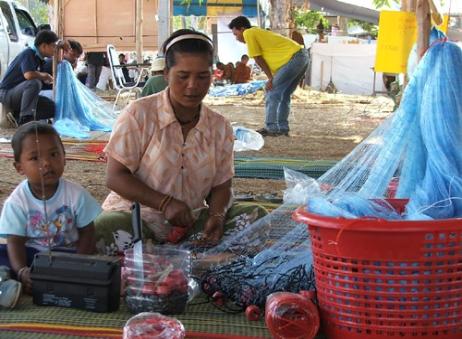
Pictures received today of the people of Baa Nam Khem attending to the third lorry load of supplies we delivered
to them. This consisted of enough tackle and nets to fit out the 10 boats that are to be built initially in the new
boat yard.
Head man Mathree said;
"This was the first time many of the villagers had felt they were 'back at work' since the Tsunami struck. Whilst
the boats are being built we will not wait and so the nets will be used to fish with by the men without the boats.
The really important thing is to get them back to some form of normality again, as every day passes we crave more
and more to get on with our lives and feel we are making some progress. The excitement could be felt when we
transformed the temporary camp site into something that finally resembled a 'fishing village' - the sight of nets and
tackle was like a medicine"
Pictures received today of the people of Baa Nam Khem attending to the third lorry load of supplies we delivered
to them. This consisted of enough tackle and nets to fit out the 10 boats that are to be built initially in the new
boat yard.
Head man Mathree said;
"This was the first time many of the villagers had felt they were 'back at work' since the Tsunami struck. Whilst
the boats are being built we will not wait and so the nets will be used to fish with by the men without the boats.
The really important thing is to get them back to some form of normality again, as every day passes we crave more
and more to get on with our lives and feel we are making some progress. The excitement could be felt when we
transformed the temporary camp site into something that finally resembled a 'fishing village' - the sight of nets and
tackle was like a medicine"
Scroll down the page for the latest updates from February, March & April. See also, on the left, links for you to find the latest Operational Status for the Regions Hotels |
Waree and Peter Warsop
pwarsop@gmail.com
pwarsop@gmail.com